


Resource Center
What Is a Consent Management Platform, and Does Your Business Need One?
Type: Blog
Topic: Consent Mgmt

Most organizations collect customer consent across multiple touchpoints, but those records often live in systems that don’t communicate with each other. A consent management platform (CMP) centralizes consent data in a single repository. It gives organizations a way to prove when and how a customer gave permission before their data was collected or used, and it processes revocations across all connected systems when customers withdraw that permission.
Federal and state regulations impose strict requirements on how organizations collect, record, and act on customer consent. Violations can result in class-action lawsuits, regulatory fines, and lasting reputational damage. For companies that operate across multiple states or communicate to customers through more than one channel, tracking consent through spreadsheets or disconnected systems creates real regulatory exposure.
MyPreferences® is PossibleNOW’s enterprise CMP, built for exactly this kind of complexity. It centralizes consent data across business units and jurisdictions, connects to over 200 marketing and operational platforms, and maintains the audit trail organizations need to demonstrate compliance on demand.
Your business likely needs a consent management platform if:
- Customer data is collected across multiple channels
- Operations span more than one state or country
- Outbound campaigns require prior consent under federal or state law
- Third-party vendors handle customer data on your behalf
- Audits require documented proof of consent
Getting Started is Just a Call Away

“Effective consent management helps businesses reach the largest possible audience while reducing compliance risk. MyPreferences® gives organizations a single place to capture consent, track revocations, and distribute that data to every system that touches the customer.”
What Does a Consent Management Platform Do?
A CMP gives organizations a structured way to collect consent and maintain the information needed to act on it. Instead of leaving consent records inside individual forms or applications, the platform can centralize each customer’s consent status and make it available to other business systems.
This is especially important for large companies. A customer might provide consent through a website and later change that decision through a service portal. The updated choice needs to reach the systems responsible for future interactions.
At a high level, a CMP helps businesses:
- Capture consent at relevant points in the customer journey
- Record when and where consent was collected
- Maintain the disclosure language associated with a decision
- Track changes and withdrawals over time
- Share current consent status with connected systems
For a closer look at the process behind these functions, see how CMPs work.
Key Capabilities of a Consent Management Platform
Not every CMP is built for enterprise complexity. The platforms that serve large, multi-jurisdictional organizations typically feature a core set of capabilities:
- Consent capture across channels: Collecting opt-ins at web, mobile, call center, and in-person touchpoints through configurable experiences, including single-click checkboxes and multi-step consent flows.
- Centralized consent storage: Maintaining a single repository for all consent records, linking each record to the individual, the specific purpose, the disclosure language, and the channel of collection.
- Jurisdictional configuration: Adapting consent language, rules, and workflows by locale, regulation, and customer type without requiring custom development for each jurisdiction.
- Revocation and opt-out handling: Processing consent withdrawals and propagating suppression status across all connected systems so no downstream platform contacts a customer who has opted out.
- Audit trail and compliance readiness: Retaining a complete, timestamped history of consent text, source, date/time, and any modifications, accessible on demand for regulatory audits.
- Activation and integration: Distributing consent data to CRMs, marketing automation platforms, dialers, and vendor systems through APIs and pre-built connectors.
MyPreferences® is PossibleNOW’s enterprise consent management platform, built to deliver these capabilities at scale for complex, multi-brand organizations.
When Does a Business Need Consent Management?
Any business that collects personal data and uses it to communicate with customers needs some form of consent management. Once consent is being collected through several customer-facing channels and relied on by multiple teams, manual records become too difficult to keep accurate and current.
A centralized consent management platform replaces those disconnected records with one system for storing and updating consent.
Common signs that a centralized CMP is needed include:
- Consent records are stored in disconnected systems
- Different departments or vendors collect consent separately
- The business operates across multiple jurisdictions
- Teams cannot easily verify a customer’s current consent status
- Consent changes do not update consistently across systems
- Consent history is incomplete or difficult to retrieve
Without a central system, one department may record a consent change while another continues working from outdated information. That can lead to unwanted outreach and greater compliance risk.
Businesses evaluating whether a CMP is mandatory should start with the laws that apply to their use cases. They should then consider whether their existing processes can reliably capture and operationalize customer decisions at scale.
Industries That Use CMPs
Consent management applies broadly, but certain industries face especially complex requirements because of the volume of customer communications, the sensitivity of the data involved, or the number of jurisdictions in play:
- Financial services: High volumes of regulated customer communications and strict data privacy requirements across banking, lending, and investment services.
- Insurance (property/casualty and health): Consent requirements span policy servicing, claims, and marketing outreach. Outbound calling campaigns add additional regulatory exposure.
- Healthcare: Patient consent for marketing communications is separate from treatment-related consent and subject to both HIPAA and state privacy laws.
- E-commerce and retail: High-volume data collection across web, mobile, and email channels, often spanning multiple states and countries with different consent rules.
- Telecommunications and media: Large subscriber bases generate high opt-out volume, and promotional outreach must align with both federal and state rules.
- Travel and hospitality: Cross-border operations mean guests and customers may be subject to different consent regimes depending on their location.
- Utilities: Regulated communications, growing digital engagement, and large customer bases require centralized consent tracking.
Any organization that communicates with customers across channels and operates in more than one jurisdiction faces the same core challenge: proving that every interaction is backed by valid, documented consent.
What Laws and Regulations Govern Consent Management?
There is no single consent rule that applies to every organization or customer interaction. Requirements vary by jurisdiction and by the activity involved.
U.S. Federal Laws and Regulations
Several federal laws and regulations create consent or opt-out obligations for specific forms of customer engagement.
The Telephone Consumer Protection Act (TCPA) regulates certain calls and texts. FCC rules also address how consumers can revoke consent for covered robocalls and robotexts. The FCC requires applicable revocation requests to be honored within a reasonable time that does not exceed 10 business days.
The FTC’s Telemarketing Sales Rule (TSR) governs telemarketing practices and the National Do Not Call Registry. It also recognizes written permission under specified conditions for calls to consumers whose numbers appear on the National Registry.
The CAN-SPAM Act governs commercial email. It does not generally require prior consent before a business sends commercial email, but recipients must have a way to opt out. Businesses must honor those requests no more than 10 business days after the request is received.
The Children’s Online Privacy Protection Act (COPPA) creates separate consent requirements for covered online services involving children under 13. Operators generally must obtain verifiable parental consent before collecting personal information from a child, subject to limited exceptions.
U.S. State Privacy and Consumer Protection Laws
Approximately 20 states now have comprehensive consumer privacy laws in effect. California’s Consumer Privacy Act (CCPA), as amended by the California Privacy Rights Act (CPRA), is the most expansive, granting consumers the right to know, delete, correct, and opt out of the sale or sharing of their personal information.
Other states with active laws include Virginia, Colorado, Connecticut, Utah, Texas, Oregon, Indiana, Kentucky, and others. Each sets its own thresholds for applicability, consumer rights, and enforcement mechanisms. Several states have also enacted mini-TCPA statutes with broader definitions of regulated technology and stricter penalties for calls and texts.
This patchwork means a single national approach to consent is insufficient. A CMP must be configurable by jurisdiction to account for differences in what consent is required, how it must be obtained, and how long records must be retained.
International Privacy and Consent Laws
The EU’s GDPR sets the most stringent international standard, requiring that consent be explicit, informed, freely given, and specific to a stated purpose before personal data can be collected. It also requires that individuals be able to withdraw consent at any time.
Canada’s Personal Information Protection and Electronic Documents Act (PIPEDA), along with provincial laws such as Quebec’s Law 25, imposes consent requirements for the collection and use of personal information. For commercial electronic messages, Canada’s Anti-Spam Legislation (CASL) generally requires express or implied consent. Senders should also be prepared to demonstrate that consent when required.
According to the International Association of Privacy Professionals (IAPP), more than 140 countries have enacted data protection or privacy laws. For organizations with international operations, a CMP must support multilingual consent experiences and jurisdiction-specific compliance rules.
Managing consent across multiple jurisdictions requires a clear understanding of what consent management involves and why it matters for data compliance.
The Difference Between Consent Management and Preference Management
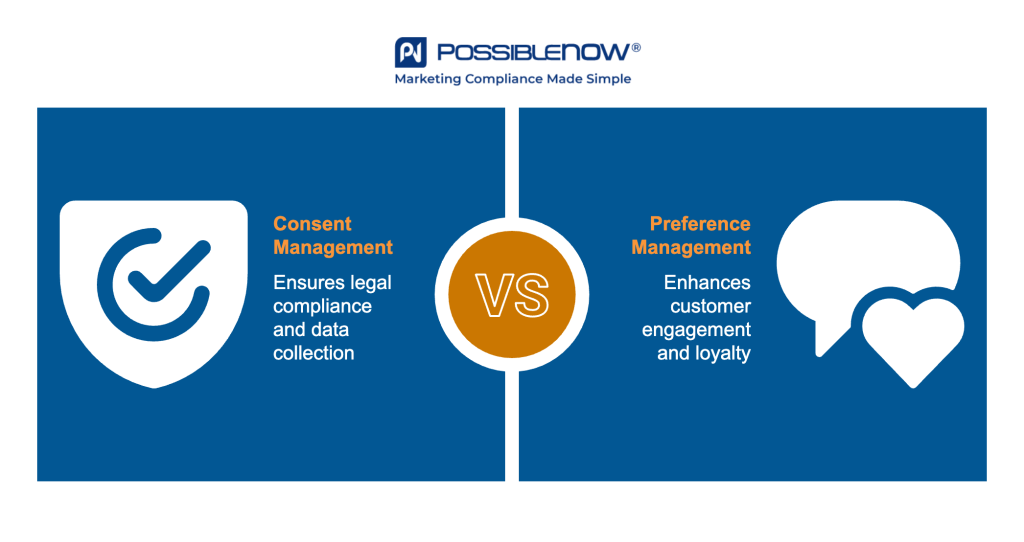
Consent management and preference management address different customer decisions. Both can work together within the same customer experience.
- Consent management focuses on permission and applicable legal choices. It records what a customer agreed to and preserves the history of that decision.
- Preference management captures how a customer wants to interact with a brand. Preferences may address communication channels or frequency. They can also include content interests and other customer-selected choices.
For example, a customer may have valid consent to receive a particular type of communication but prefer email instead of text. Another customer may want product updates only once a month. Managing both types of choices helps the business respect the customer’s stated expectations.
A combined approach also gives customers greater control. Instead of forcing an all-or-nothing choice, organizations can provide appropriate preference options while still offering a clear way to opt out completely where required.
With MyPreferences®, consent and preference data live in the same platform, giving businesses a centralized record of customer choices and the history behind them.
What Enterprises Should Look for in a Consent Management Platform
CMPs vary widely in the level of complexity they are designed to manage. Enterprises need a platform that can handle consent across multiple brands, jurisdictions, and customer segments while keeping those requirements coordinated within one system.
Key evaluation criteria:
- Jurisdictional configurability: Can the platform adapt consent flows, disclosure language, and compliance rules by state, country, and regulation without custom development?
- Integration depth: Does it connect to existing CRM, marketing automation, call center, and analytics platforms? Enterprises should look for platforms with extensive pre-built connector libraries and robust API support.
- Audit readiness: Does it maintain a complete, timestamped history of consent language, source, date/time, and any modifications, accessible on demand for regulatory review?
- Scalability across business units: Can it support multiple brands, departments, regions, and customer segments within a single instance?
- Real-time revocation handling: Does it process opt-outs and consent withdrawals immediately and propagate them across all downstream systems?
- Zero-party data support: Does it go beyond consent to capture preferences, feedback, and profile data that customers voluntarily share, creating a richer foundation for personalization?
Compliance-by-design architecture: Will the platform evolve as regulations change, or will updates require rebuilding consent workflows from scratch?
Download Our Consent & Preference Management Buyer’s Kit
Why Choose MyPreferences, PossibleNOW’s Consent Management Platform?
Organizations managing consent across multiple jurisdictions, brands, and customer touchpoints need a platform purpose-built for that complexity. A basic cookie consent tool or a CMP bolted onto another system can’t deliver the configurability, audit depth, or integration breadth that enterprise compliance requires.
MyPreferences® was designed from the ground up as an enterprise consent management platform.
Key capabilities include:
- Universal Consent Repository: Centralizes consent information and maintains historical records.
- Configurable consent collection: Supports consent experiences based on specific business requirements or customer contexts.
- Localization: Allows consent language and experiences to be configured for different locales.
- Granular audit history: Records consent language and source information. It also maintains the date and time associated with the decision.
- Revocation management: Captures consent changes and distributes updated status to relevant systems.
- Integrated preference management: Manages customer preferences alongside consent data.
- Enterprise connectivity: Integrates with existing technology environments so consent information can be used where customer interactions occur.
- No-code experiences: Supports responsive data-collection experiences without requiring every change to become a development project.
- Scalable configuration: Accommodates complex consent structures across brands and business units.
Managing consent across a complex organization requires the right platform and the right strategy. Contact PossibleNOW to learn how MyPreferences reduces compliance risk and enables personalized customer engagement across every touchpoint.
-
TCPA Regulations and Compliance: Complete Guide
Type: Blog
Topic: Do Not Call Solution
-
Defining Meaningful Metrics: 6 Soft KPIs to Measure Customer Preference Collection
Type: Blog
Topic: Preference Mgmt
-
Email Preference Center Best Practices
Type: Blog
Topic: Preference Mgmt
-
The Basics of DNC Scrubbing: What Is a Do Not Call (DNC) Scrubber and Why Do You Need It?
Type: Blog
Topic: Do Not Call Solution
-
What is Consent Management, How it Works, & Why it’s Important for Data Compliance
Type: Blog
Topic: Consent Mgmt
-
Do Insurance Companies Cover TCPA Damages?
Type: Blog
Topic: Do Not Call Solution
-
8 Best Practices for Capturing GDPR Consent
Type: Webinars
-
Data Silos Cause Communication Gaps
Type: Videos
Topic: Preference Mgmt
-
Difference Between Preferences & Consent
Type: Videos
Topic: Preference Mgmt
-
Integrate Do Not Call Compliance with Preferences
Type: Videos
Topic: Preference Mgmt
-
Customer Preferences Require More Than One Flavor
Type: Videos
Topic: Preference Mgmt
-
Give Customers Opt-Down Options
Type: Videos
Topic: Preference Mgmt
-
Preference Center Organization
Type: Videos
Topic: Preference Mgmt
-
Strategic Consultants Benefited Scotiabank
Type: Videos
Topic: Industry Testimonials
-
The Ultimate DNC Compliance Checklist Before Launching Your Next Campaign
Type: Blog
Topic: Do Not Call Solution
-
The Impact of AI on Automating DNC Processes
Type: Blog
Topic: Do Not Call Solution
-
Why DNC Compliance Needs Regular Auditing
Type: Blog
Topic: Do Not Call Solution
View Other Resources


