


Resource Center
Is It Mandatory to Have a Consent Management Platform?
Type: Blog
Topic: Consent Mgmt

Federal and state laws impose specific consent obligations on businesses that collect personal data or conduct outbound marketing. However, no regulation prescribes a particular technology or platform type for managing those obligations. The mandate is about the outcome, not the tool.
Meeting consent requirements across multiple jurisdictions takes more than good intentions. Every consent needs to be captured with full context, stored in an auditable format, and shared across all systems and vendors in real time. Organizations that leave cracks in this process face enforcement actions, steep financial penalties, and litigation.
PossibleNOW’s MyPreferences® consent management platform is purpose-built to address these requirements at enterprise scale.
The consequences of not using a CMP are well-documented:
- Regulatory fines under federal and state telemarketing and privacy laws
- Class-action lawsuits
- Loss of safe harbor protections
- Reputational damage from public enforcement actions
- Growing exposure as new state privacy laws take effect
- Revenue loss from fragmented consent data
Getting Started is Just a Call Away

“MyPreferences® captures every consent event with the timestamp, source, and terms the customer agreed to, then distributes that status to every connected platform in real time. When a regulator or plaintiff asks for proof that consent was obtained and honored correctly, organizations that use the platform can produce it on demand.”
What Does the Law Require When It Comes to Consent?
Federal and state regulations each impose their own consent requirements, and the obligations differ by channel, by jurisdiction, and by the type of data being collected. Organizations that operate across states or communicate through more than one channel face overlapping requirements that must be tracked independently.
Federal Consent Requirements
The Telephone Consumer Protection Act (TCPA) requires prior express consent for certain calls and texts made using regulated technology. For telemarketing calls or texts to wireless numbers that use an autodialer or artificial or prerecorded voice, businesses must obtain prior express written consent. Consent must be tied to a specific communication method or campaign and documented with the timestamp, the source, and the language the consumer agreed to.
The FTC’s Telemarketing Sales Rule (TSR) governs the National Do Not Call Registry and requires businesses to honor opt-out requests as soon as possible, and no later than 10 business days after the request is received. Internal suppression lists must retain opt-out records for at least five years, though some states require 10 years, and many businesses choose to retain them indefinitely as a best practice.
State Consent Requirements
More than 20 states have enacted comprehensive privacy laws that impose consent requirements on businesses that collect or process personal data. Most require opt-in consent before processing sensitive personal data, including health information and biometric data. These laws also require businesses to provide clear privacy notices, honor consumer data rights, and maintain verifiable consent records.
The specifics vary by state. No federal comprehensive privacy law exists, so businesses operating nationally must track each state’s requirements independently.
Separate from data privacy, several states have enacted their own TCPA-like telemarketing statutes that go beyond federal requirements. States including Florida, Oklahoma, and Maryland impose additional damages and apply broader definitions of regulated technology, increasing compliance exposure for outbound campaigns.
Penalties and Consequences of Non-Compliance
A single compliance failure can create exposure under more than one federal or state law.
- TCPA damages: Statutory damages can range from $500 to $1,500 per violation, depending on whether the violation is found to be willful or knowing.
- TSR penalties: Civil penalties can reach up to more than $53,000 per non-compliant contact.
- State mini-TCPA exposure: States including Florida, Oklahoma, and Maryland impose additional requirements that can create separate liability on top of federal penalties.
- State privacy enforcement: Attorneys general and privacy regulators can impose substantial penalties for failures involving consent or opt-out rights.
- Class-action risk: Repeated violations can increase exposure through consumer litigation.
- Reputational damage: Public enforcement actions can erode customer trust long after the legal matter is resolved.
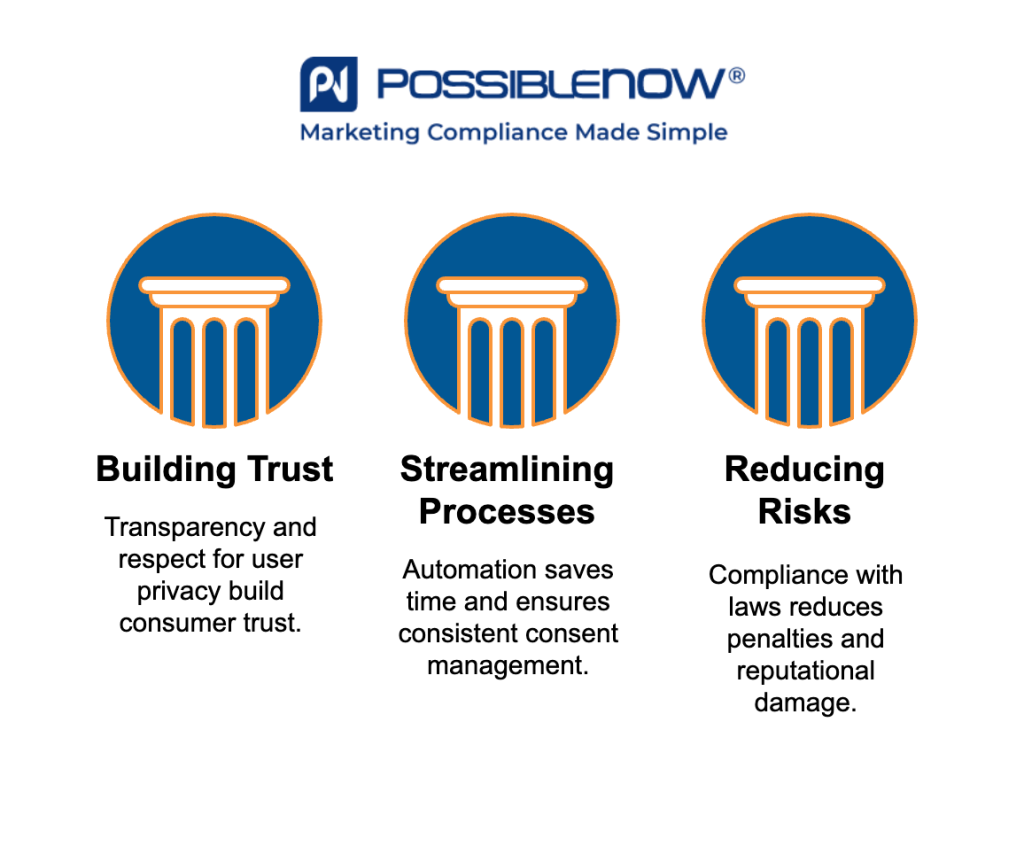
This combined exposure is a key reason why businesses need a consent management platform to manage consent and opt-out obligations consistently at scale.
How a Consent Management Platform Helps Protect Your Business
A CMP prevents prohibited contacts and preserves the widest possible pool of eligible contacts for outreach.
Centralized Consent Records and Audit Readiness
A CMP captures every consent and revocation with full context: the channel, the timestamp, and the specific terms the consumer agreed to. That record is stored centrally and accessible whenever documentation is needed for regulatory inquiries or litigation. Without it, businesses may struggle to prove compliance even when they acted in good faith.
Real-Time Propagation Across Systems and Channels
When a consumer revokes consent or opts out, that update must reach every system involved in customer communication before the next contact attempt. A CMP propagates updates in real time to CRMs, dialers, email platforms, and vendor systems, so every team and partner operates from the same data.
Adaptability to Evolving Regulations
New state privacy laws take effect regularly, each with its own consent language requirements and enforcement standards. A CMP with configurable rules allows businesses to adjust consent experiences by jurisdiction and channel without rebuilding infrastructure for each new law.
Preserving Reachable Audience While Staying Compliant
When consent data is fragmented or out of date, businesses may over-suppress and lose access to people who have given valid permission to be contacted. A CMP that maintains accurate, current records across all systems helps marketing teams reach every eligible contact with confidence while keeping outreach aligned with documented consumer choices.
PossibleNOW’s Consent Management Platform Is Built for Enterprise Complexity
Managing consent at enterprise scale means coordinating across business units, vendors, channels, and jurisdictions. PossibleNOW provides the technology and expertise to handle that complexity.
- MyPreferences® captures consent at every touchpoint and stores it in a central repository that distributes updates to all connected platforms in real time. It supports configurable consent language by jurisdiction, hierarchical consent structures with automatic revocation, and full audit history with timestamps and source detail.
- DNCSolution® is natively integrated with MyPreferences and scrubs contact lists against federal, state, wireless, and internal DNC registries. It also supports Reassigned Numbers Database verification and known TCPA litigator identification.
- RegInfoHub® provides continuously updated regulatory intelligence covering federal and state requirements for phone, text, email, fax, and prerecorded message channels.
- Strategic Consulting and Implementation Services help businesses design and deploy consent and preference management programs tailored to complex enterprise environments.
Operating without a centralized consent management platform leaves businesses exposed to compounding regulatory risk across every channel and jurisdiction. PossibleNOW’s MyPreferences platform provides the infrastructure to capture and distribute consent data at enterprise scale, backed by natively integrated DNC compliance and continuously updated regulatory intelligence.
Learn more about what a consent management platform is and how MyPreferences® can strengthen your organization’s consent management program. Contact PossibleNOW today.
Download Our Consent & Preference Management Buyer’s Kit
-
TCPA Regulations and Compliance: Complete Guide
Type: Blog
Topic: Do Not Call Solution
-
Defining Meaningful Metrics: 6 Soft KPIs to Measure Customer Preference Collection
Type: Blog
Topic: Preference Mgmt
-
Email Preference Center Best Practices
Type: Blog
Topic: Preference Mgmt
-
The Basics of DNC Scrubbing: What Is a Do Not Call (DNC) Scrubber and Why Do You Need It?
Type: Blog
Topic: Do Not Call Solution
-
What is Consent Management, How it Works, & Why it’s Important for Data Compliance
Type: Blog
Topic: Consent Mgmt
-
Do Insurance Companies Cover TCPA Damages?
Type: Blog
Topic: Do Not Call Solution
-
8 Best Practices for Capturing GDPR Consent
Type: Webinars
-
Data Silos Cause Communication Gaps
Type: Videos
Topic: Preference Mgmt
-
Difference Between Preferences & Consent
Type: Videos
Topic: Preference Mgmt
-
Integrate Do Not Call Compliance with Preferences
Type: Videos
Topic: Preference Mgmt
-
Customer Preferences Require More Than One Flavor
Type: Videos
Topic: Preference Mgmt
-
Give Customers Opt-Down Options
Type: Videos
Topic: Preference Mgmt
-
Preference Center Organization
Type: Videos
Topic: Preference Mgmt
-
Strategic Consultants Benefited Scotiabank
Type: Videos
Topic: Industry Testimonials
-
The Ultimate DNC Compliance Checklist Before Launching Your Next Campaign
Type: Blog
Topic: Do Not Call Solution
-
The Impact of AI on Automating DNC Processes
Type: Blog
Topic: Do Not Call Solution
-
Why DNC Compliance Needs Regular Auditing
Type: Blog
Topic: Do Not Call Solution
View Other Resources


