


Resource Center
What Is the Difference Between a State and National Do Not Call List?
Type: Blog
Topic: Do Not Call Solution

Checking the National Do Not Call Registry is an essential step before launching a telemarketing campaign—but it’s typically not the only list a business needs to check. Several states maintain separate Do Not Call lists, and every business must also honor consumers who ask the company directly to stop calling.
These overlapping requirements can become difficult to manage across multiple call centers, business units, systems, and vendors. A number considered callable under one set of rules may still be restricted by another.
PossibleNOW’s DNCSolution® provides national and state DNC scrubbing software that automates compliance across all applicable registries, reducing violation risk and the operational burden of multi-jurisdictional list management.
The following sections, you’ll find information on:
Speak With an Expert Today

“Complexity increases when rules vary by jurisdiction and systems do not align. Centralize opt-out data and implement consistent decision logic across all tools and vendors.”
Key Differences Between State and National Do Not Call Lists
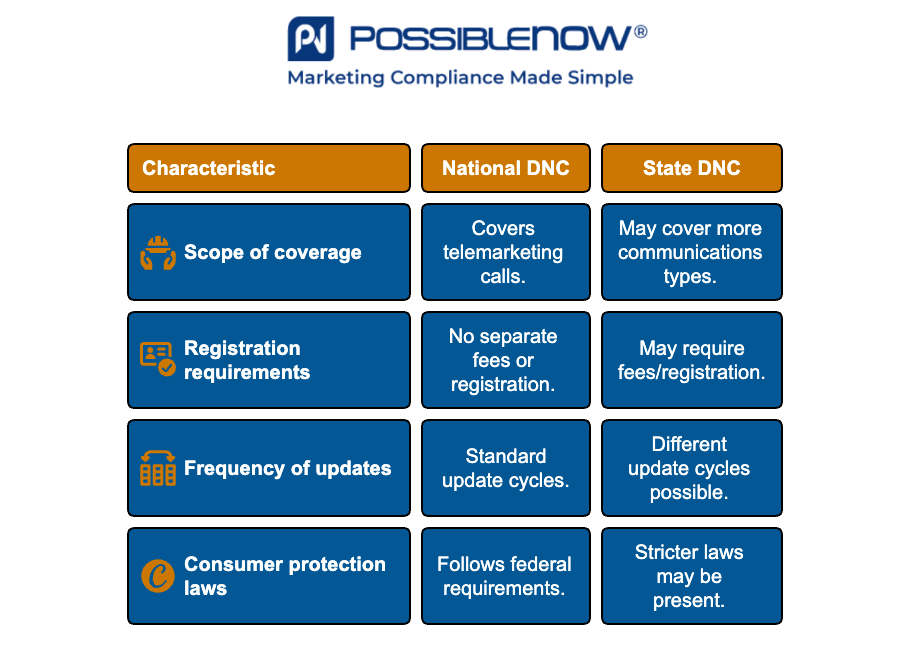
National and state lists share the same basic goal: protecting consumers from unwanted telemarketing calls. The requirements for businesses, however, are not always the same.
Administration and Coverage
The National Registry provides a federal baseline for covered telemarketing sales calls throughout the United States.
State lists apply within specific jurisdictions. A state may define covered calls, consumers, telephone numbers, or exemptions differently from federal rules.
Registration and List Access
Businesses access the National Registry through the federal registration and subscription process. Fees may apply depending on how many area codes a business accesses.
States may have separate requirements involving:
- Telemarketer registration
- Licenses or bonds
- List-access subscriptions
- State fees
- Renewal deadlines
Accessing the National Registry does not automatically satisfy these separate state obligations.
Exemptions
Federal exemptions do not always carry over to the state level. A state may narrow an established business relationship exemption, treat certain organizations differently, or require additional documentation.
Businesses should validate permission and exemptions against every applicable jurisdiction rather than applying one federal standard nationwide.
Update Schedules
The National Registry must be accessed at least every 31 days for covered calling activity. State lists may follow different publication or refresh schedules.
A multistate campaign may therefore require several suppression files to be updated on different timelines. Using outdated data can expose a company to complaints, regulatory action, and additional state penalties.
Enforcement
Federal and state authorities can enforce their respective requirements. A call may create exposure under both levels of law when the number appears on national and state lists.
Under the TSR, federal civil penalties can reach up to more than $53,000 per non-compliant contact. The Telephone Consumer Protection Act (TCPA) adds further requirements for calls made using autodialers or prerecorded messages, with statutory damages ranging from $500 to $1,500 per violation.
States may impose additional fines or provide other remedies under their own laws. A single non-compliant call or text can trigger penalties under both federal and state law simultaneously.
The Challenges of Managing Multiple DNC Lists
Maintaining compliance across national, state, and internal DNC lists creates real operational complexity, especially for organizations with large contact databases, multiple business units, or third-party calling partners.
Common challenges include:
- Different list schedules: National and state suppression data may be updated at different intervals.
- Varying exemptions: Permission that supports a call under federal rules may not satisfy a state requirement.
- Disconnected systems: A suppression request captured in one CRM may not reach another dialer or call center.
- Third-party outreach: Vendors may use separate lists, technology, or decision logic.
- Incomplete records: Businesses may struggle to document which lists and exemptions were checked before a call.
- Expanding operations: Entering a new state can introduce registration and suppression requirements that were not part of the original campaign process.
Courts have consistently found that brands are responsible for the actions of their third-party marketing partners, including lead generators, vendors, and remarketers. Centralized rules and documented vendor processes are critical when outreach is handled outside the organization.
Businesses evaluating their current approach can review the best tools for managing Do Not Contact lists and identify where manual processes or disconnected systems create gaps.
Request a Demo Today
Managing State and National Lists with DNCSolution®
PossibleNOW’s DNCSolution® provides one platform for managing national, state, wireless, and company-specific DNC list scrubbing.
DNCSolution helps businesses:
- Scrub high-volume calling lists against applicable registries.
- Automate scheduled re-scrubbing.
- Apply centralized suppression and exemption rules.
- Connect compliance checks with CRMs, dialers, and campaign systems.
- Support multiple campaigns, call centers, and vendors.
- Maintain scrub receipts, reports, and historical audit records.
- Apply geographic restrictions for state holidays and declared emergencies.
These controls reduce reliance on manual list handling and help organizations maintain a consistent, defensible process across outbound operations. DNCSolution is backed by PossibleNOW’s compliance guarantee.
RegInfoHub® also gives teams access to current federal and state telemarketing requirements, helping them monitor changes that may affect calling campaigns.
Contact PossibleNOW to see how DNCSolution can simplify national, state, and internal DNC list management.

-
TCPA Regulations and Compliance: Complete Guide
Type: Blog
Topic: Do Not Call Solution
-
Defining Meaningful Metrics: 6 Soft KPIs to Measure Customer Preference Collection
Type: Blog
Topic: Preference Mgmt
-
Email Preference Center Best Practices
Type: Blog
Topic: Preference Mgmt
-
The Basics of DNC Scrubbing: What Is a Do Not Call (DNC) Scrubber and Why Do You Need It?
Type: Blog
Topic: Do Not Call Solution
-
What is Consent Management, How it Works, & Why it’s Important for Data Compliance
Type: Blog
Topic: Consent Mgmt
-
Do Insurance Companies Cover TCPA Damages?
Type: Blog
Topic: Do Not Call Solution
-
8 Best Practices for Capturing GDPR Consent
Type: Webinars
-
Data Silos Cause Communication Gaps
Type: Videos
Topic: Preference Mgmt
-
Difference Between Preferences & Consent
Type: Videos
Topic: Preference Mgmt
-
Integrate Do Not Call Compliance with Preferences
Type: Videos
Topic: Preference Mgmt
-
Customer Preferences Require More Than One Flavor
Type: Videos
Topic: Preference Mgmt
-
Give Customers Opt-Down Options
Type: Videos
Topic: Preference Mgmt
-
Preference Center Organization
Type: Videos
Topic: Preference Mgmt
-
Strategic Consultants Benefited Scotiabank
Type: Videos
Topic: Industry Testimonials
-
The Ultimate DNC Compliance Checklist Before Launching Your Next Campaign
Type: Blog
Topic: Do Not Call Solution
-
The Impact of AI on Automating DNC Processes
Type: Blog
Topic: Do Not Call Solution
-
Why DNC Compliance Needs Regular Auditing
Type: Blog
Topic: Do Not Call Solution
View Other Resources


