


Resource Center
What Are the B2B Telemarketing Consent Requirements?
Type: Blog
Topic: Do Not Call Solution

B2B telemarketing calls are generally subject to the same federal and state consent rules that govern consumer outreach. Many B2B organizations assume otherwise, and that assumption is one of the most common reasons callers end up facing enforcement actions and litigation.
The requirements are specific and the penalties for getting them wrong are steep. PossibleNOW’s DNCSolution® helps B2B teams manage consent, automate suppression, and maintain defensible compliance records across every jurisdiction where they operate. With the right compliance infrastructure in place, organizations can scale outbound campaigns without suppressing otherwise callable numbers simply because the compliance status is unclear.
Speak With an Expert Today

“Consent requirements are easiest to manage when standardized. Capture consent consistently, suppress quickly, and keep proof that supports your outreach decisions.”
Key Compliance Requirements for B2B Telemarketing
Federal and state regulations govern B2B telemarketing across call types and technologies. The requirements below apply broadly, with additional obligations triggered by the type of number contacted, the dialing technology used, and the state where the recipient is located.
1. Identify the Number Type Before Calling
The compliance obligations for a B2B call depend on whether the contact number is wireless or landline. Wireless numbers trigger the strictest consent requirements under the Telephone Consumer Protection Act (TCPA), including prior express written consent for any automated or prerecorded marketing outreach. This applies even when the wireless number belongs to a business contact.
Business landlines face fewer federal restrictions, but many professionals use a single mobile device for both business and personal purposes. Some states make no distinction between business and personal lines. The safest operational approach is to confirm the number type before placing the call and treat any number that could be wireless as subject to full TCPA requirements.
2. Obtain Required Consent for Automated and Prerecorded Telemarketing
Marketing calls or texts to wireless numbers using ATDS (automated telephone dialing system), prerecorded voice, or automated messaging require prior express written consent.
To meet TCPA compliance standards, that consent must include:
- A clear disclosure that the communication is for marketing purposes
- Notification that calls or texts may be sent using an ATDS
- A statement that consent is not a condition of any purchase
- Identification of the brand making the call and the specific number being contacted
Express consent can be obtained through e-signature, form submission, or any documented action that includes the required disclosure language.
3. Scrub Against Applicable Do Not Call Registries
Calling lists must be scrubbed against the National Do Not Call Registry at least every 31 days. This applies to both in-house and vendor-run campaigns.
Some states maintain their own DNC registries with additional requirements, and several offer no B2B exemptions from their DNC rules. Failing to account for state registries alongside the national list leaves gaps that regulators and plaintiffs can exploit.
4. Honor Company-Specific Do Not Call Requests
When a business contact requests no further calls or texts, that request must be honored as soon as possible and no later than 10 business days after the request is received. The number must be added to the organization’s internal suppression list for at least five years, though some states require 10 years, and many businesses retain these records indefinitely as best practice.
A business number is not a blanket permission to call. If a contact at that number has opted out, the suppression applies regardless of the number type.
5. Follow Applicable Caller Identification and Disclosure Rules
The FTC’s Telemarketing Sales Rule (TSR) requires telemarketers to identify themselves and state the purpose of the call clearly and promptly. Misrepresentation of products, services, or terms is prohibited. Accurate caller identification also reduces the likelihood of calls being flagged or blocked by carriers.
6. Observe Applicable Calling Hour Restrictions
Federal rules prohibit calling residences outside 8 a.m. to 9 p.m. local time. Many states impose stricter calling windows, and these restrictions apply based on the recipient’s physical location, not the area code of the number.
7. Check State-Specific Telemarketing Requirements
Several states have enacted mini-TCPA statutes that go beyond federal rules. Florida, Oklahoma, and Maryland are examples of states that expand definitions of regulated technology, impose stricter consent standards, and carry higher statutory damages. Some states offer no exemptions for B2B communications. Requirements must be evaluated per jurisdiction before outreach begins.
8. Maintain Defensible Compliance Records
Consent artifacts, scrub receipts, call logs, and opt-out timestamps must be documented and retained. If a call or text is challenged, these records form the foundation of a defensible position. Without them, even compliant outreach becomes difficult to prove.
Exemptions That May Apply to B2B Telemarketing
Certain B2B communications may qualify for exemptions from the strictest TCPA and TSR requirements. But these exemptions are narrower than many organizations assume, and relying on them without verification creates risk. For a detailed breakdown, see DNC exemptions for B2B calls.
Established Business Relationship (EBR)
An existing customer or transactional relationship may exempt a call from the National DNC Registry scrubbing requirement. However, an EBR does not waive TCPA consent requirements for automated or prerecorded calls to wireless numbers. The relationship must be documented and current, and it does not apply if the contact has filed an entity-specific DNC request.
Prior Express Permission
Documented permission from the recipient is a core exemption to the National DNC Registry in its own right. This includes both express written consent and prior express invitation or permission. That permission must be current and verifiable. Always confirm that no entity-specific DNC request has been filed before relying on this exemption.
Calls to Dedicated Business Landlines
Calls to a number that is exclusively a business landline face fewer TCPA restrictions. But this exemption is only reliable when the number’s status can be confirmed. If the number is a mobile device used for business, full TCPA standards apply.
Non-Marketing Communications
Calls related to account servicing, appointment reminders, or billing notifications generally fall outside the TCPA’s marketing rules. Any promotional element in the call can reclassify it as marketing and trigger full consent and DNC obligations.
State laws may not recognize these exemptions. Misapplying an exemption carries the same consequences as making a call without valid consent.
Common Compliance Risks in B2B Telemarketing
B2B telemarketing violations frequently stem from incorrect assumptions about what the law allows. Common risks include:
- Treating every business number as exempt. A business database can contain wireless or mixed-use numbers that trigger different requirements.
- Relying too broadly on an EBR. An established relationship does not override an entity-specific opt-out or authorize every form of regulated outreach.
- Missing company-specific DNC requests. Suppression gaps can cause calls to continue after a recipient has asked them to stop.
- Using outdated number data. Reassigned or incorrectly classified numbers can undermine the permission relied on for outreach.
- Applying only federal rules. State laws can regulate campaigns differently and may provide fewer B2B exemptions.
- Failing to verify third-party lead practices. Courts have consistently found that brands are responsible for the actions of their third-party marketing partners, including lead generators, vendors, and remarketers.
- Keeping incomplete compliance records. Missing consent evidence or scrub history makes it harder to support the decision to contact a number.
Reviewing the TCPA vulnerabilities for B2B callers can help teams identify where existing outbound processes need stronger controls.
Best Practices for B2B Consent Management
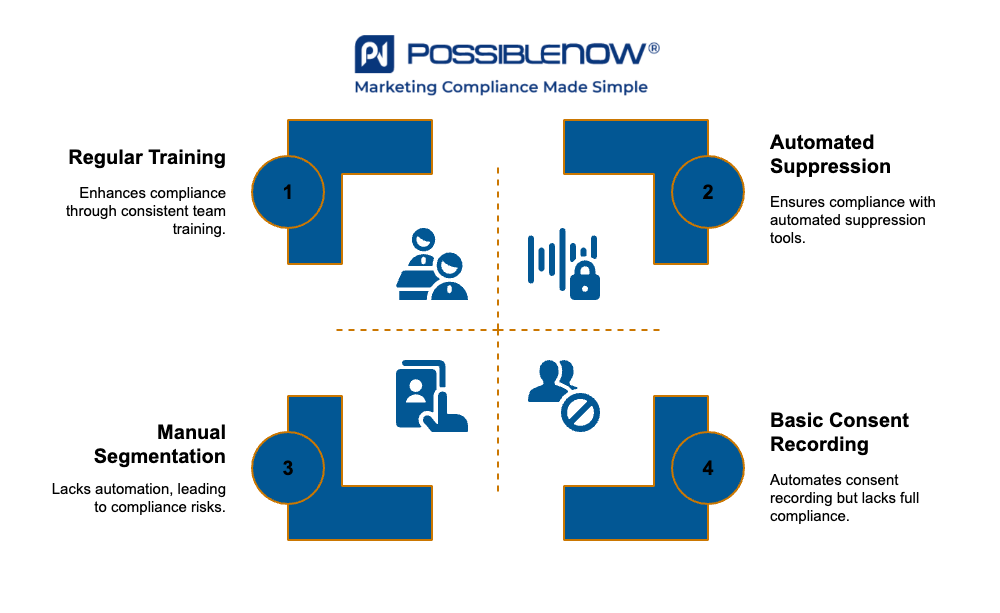
Reducing compliance risk in B2B outreach requires consistent processes, not one-time fixes.
- Train teams regularly on federal and state consent requirements, with refreshers when regulations change
- Segment wireless from landline contacts and consumer from business contacts within CRM systems to apply the correct compliance rules to each group
- Automate DNC suppression across federal, state, and internal lists through a DNC compliance for telemarketing platform
- Record consent with full context, including channel, timestamp, source, and the specific disclosure language presented
- Integrate compliance tools with CRM and dialing platforms so suppression rules are applied at the point of outreach, not after the fact
Audit consent and suppression processes regularly to identify gaps before they become violations
Request a Demo Today
How PossibleNOW Supports B2B Telemarketing Compliance
B2B outreach compliance depends on connected systems that track consent, enforce suppression, and adapt to regulatory changes across jurisdictions. PossibleNOW provides purpose-built tools for each layer of that process.
- DNCSolution® for automated scrubbing against federal, state, and internal DNC registries. The platform also supports EBR policy management and provides access to the Reassigned Numbers Database and a known TCPA litigator list.
- MyPreferences® for centralized consent and preference management across channels, with audit-ready records of every opt-in and revocation.
- RegInfoHub® for up-to-date regulatory intelligence on state and federal telemarketing requirements.
Treating B2B outreach as low-risk invites the same penalties that consumer-focused violations carry. Organizations that invest in defensible consent processes, automated suppression, and ongoing regulatory monitoring are positioned to scale outreach without compounding legal exposure.
Ready to strengthen B2B telemarketing compliance? Contact PossibleNOW to evaluate current processes and reduce risk across every outbound channel.

-
TCPA Regulations and Compliance: Complete Guide
Type: Blog
Topic: Do Not Call Solution
-
Defining Meaningful Metrics: 6 Soft KPIs to Measure Customer Preference Collection
Type: Blog
Topic: Preference Mgmt
-
Email Preference Center Best Practices
Type: Blog
Topic: Preference Mgmt
-
The Basics of DNC Scrubbing: What Is a Do Not Call (DNC) Scrubber and Why Do You Need It?
Type: Blog
Topic: Do Not Call Solution
-
What is Consent Management, How it Works, & Why it’s Important for Data Compliance
Type: Blog
Topic: Consent Mgmt
-
Do Insurance Companies Cover TCPA Damages?
Type: Blog
Topic: Do Not Call Solution
-
8 Best Practices for Capturing GDPR Consent
Type: Webinars
-
Data Silos Cause Communication Gaps
Type: Videos
Topic: Preference Mgmt
-
Difference Between Preferences & Consent
Type: Videos
Topic: Preference Mgmt
-
Integrate Do Not Call Compliance with Preferences
Type: Videos
Topic: Preference Mgmt
-
Customer Preferences Require More Than One Flavor
Type: Videos
Topic: Preference Mgmt
-
Give Customers Opt-Down Options
Type: Videos
Topic: Preference Mgmt
-
Preference Center Organization
Type: Videos
Topic: Preference Mgmt
-
Strategic Consultants Benefited Scotiabank
Type: Videos
Topic: Industry Testimonials
-
The Ultimate DNC Compliance Checklist Before Launching Your Next Campaign
Type: Blog
Topic: Do Not Call Solution
-
The Impact of AI on Automating DNC Processes
Type: Blog
Topic: Do Not Call Solution
-
Why DNC Compliance Needs Regular Auditing
Type: Blog
Topic: Do Not Call Solution
View Other Resources


