


Resource Center
The Privacy Laws Behind the Do Not Call Registry
Type: Blog
Topic: Do Not Call Solution
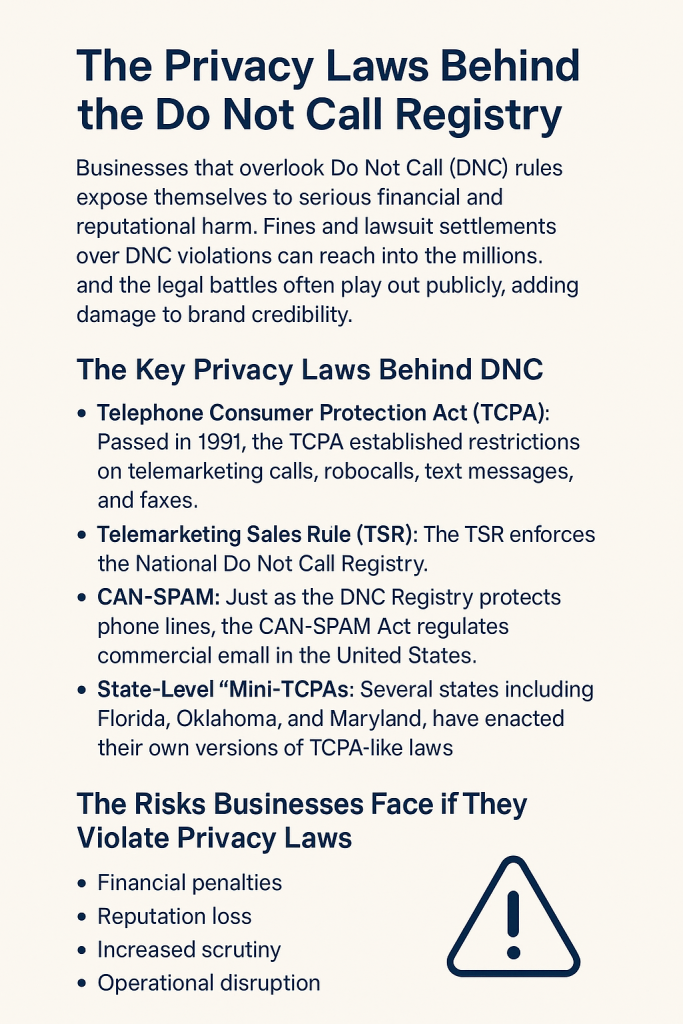
Businesses that overlook Do Not Call (DNC) rules expose themselves to serious financial and reputational harm. Fines and lawsuit settlements over DNC violations can reach into the millions, and the legal battles often play out publicly, adding damage to brand credibility. The DNC carries so much legal weight because it is part of a larger framework of U.S. privacy and telemarketing regulations, including the TSR and TCPA.
Below, we break down the privacy laws that govern the DNC Registry and explain what they mean for companies that rely on outbound calling.

“Every call to a number on the Do Not Call Registry carries legal risk. The companies that treat compliance as a core business function are more likely to avoid lawsuits and protect their brand.”
In the following sections, you’ll find information on:
Speak With an Expert Today
What Is the Do Not Call Registry?
The National Do Not Call (DNC) Registry is a federal program that gives consumers a way to opt out of telemarketing calls. Managed by the Federal Trade Commission (FTC) and enforced jointly with the Federal Communications Commission (FCC), it creates a legally binding list of numbers that businesses must avoid calling for sales purposes.
Companies that engage in telemarketing are required to access the registry through the FTC’s secure platform. After creating an account, they can download the list of registered phone numbers for the area codes where they conduct business. The registry is updated every 24 hours, and businesses are required to scrub their calling lists against it at least once every 31 days.
Telemarketing to a number on the DNC list without proper consent is considered a violation of federal law and can result in significant financial penalties, including statutory damages of up to $500 per call, or up to $1,500 per call if the violation is found to be willful.
The Key Privacy Laws Behind DNC
Telephone Consumer Protection Act (TCPA)
Passed in 1991, the TCPA established restrictions on telemarketing calls, robocalls, text messages, and faxes. It requires prior consent for certain communications and compels businesses to maintain internal do-not-call lists. Noncompliance carries significant penalties, including fines up to $1,500 per violation and average lawsuit judgments in the millions.
Telemarketing Sales Rule (TSR)
The TSR enforces the National Do Not Call Registry. It sets rules around honoring opt-outs, limiting call times, and maintaining call records. Together with the TCPA, it provides the legal foundation for consumer privacy protections in telemarketing.
CAN-SPAM
Just as the DNC Registry protects phone lines, the CAN-SPAM Act regulates commercial email in the United States. The law requires every marketing email to include a clear and functioning opt-out mechanism. Opt-out requests should be honored immediately and no later than within 10 business days. Businesses are prohibited from charging a fee or making recipients provide additional personal information beyond their email address to unsubscribe.
State-Level “Mini-TCPAs”
Several states, including Florida, Oklahoma, and Maryland, have enacted their own versions of TCPA-like laws. These “Mini-TCPAs” often go beyond federal requirements by expanding the scope of what’s regulated and imposing stricter standards and higher statutory damages.
What makes states like Oklahoma and Maryland especially noteworthy is their broader definitions of regulated technology, such as “automated systems” for dialing, texting, or initiating calls. These expansive definitions can bring activities under state law that might not otherwise trigger the federal TCPA, significantly increasing compliance risk for outbound campaigns.
The Risks Businesses Face if They Violate Privacy Laws
Violating privacy laws connected to DNC compliance exposes businesses to multiple risks:
- Financial penalties: TCPA lawsuits can reach into the millions of dollars in damages.
- Reputation loss: Customers who feel their privacy has been disregarded are more likely to disengage or complain publicly.
- Increased scrutiny: Regulators actively monitor violations, and repeat offenders may face escalated enforcement actions.
- Operational disruption: Litigation and audits drain time, resources, and focus away from growth initiatives.
How PossibleNOW Helps Businesses Strengthen Their DNC Strategy
PossibleNOW provides the tools and services to manage complex DNC regulations effectively while protecting customer trust.
- DNCSolution®: Our Do Not Call solution automatically checks calling lists against federal and state registries, internal suppression lists, and known TCPA litigators. It maintains a complete audit trail of compliance activity and integrates with platforms such as Salesforce, Oracle, and Microsoft Dynamics, embedding compliance directly into business workflows.
- Compliance Advisory Services: Delivered through our sister company CompliancePoint, these services help organizations stay ahead of shifting regulations. Our experts identify applicable federal and state requirements, assess gaps, and design corrective processes. We also provide centralized governance and ongoing monitoring to help companies maintain compliance and hold a defensible position if challenged by regulators or in court.
- Connected solutions: DNCSolution® integrates with MyPreferences® for consent and preference management and RegInfoHub® for real-time updates on changing regulations. Together, these solutions give businesses a complete framework for reducing risk while honoring consumer privacy across every channel.
Ready to take the uncertainty out of DNC compliance? PossibleNOW delivers the technology, expertise, and regulatory insight that large organizations need to protect their brand and reduce risk. Contact our team today to learn how DNCSolution® can strengthen your compliance program.
Request a Demo Today
About PossibleNOW
PossibleNOW is the pioneer and leader in customer consent, preference, and regulatory compliance solutions. We leverage our MyPreferences technology, processes, and services to enable relevant, trusted, and compliant customer interactions. Our platform empowers the collection, centralization, and distribution of customer communication consent and preferences across the
enterprise. DNCSolution addresses Do Not Contact regulations such as TCPA, CAN-SPAM and CASL, allowing companies to adhere to DNC requirements, backed by our 100% compliance guarantee.
PossibleNOW’s strategic consultants take a holistic approach, leveraging years of experience when creating strategic roadmaps, planning technology deployments, and designing customer interfaces. PossibleNOW is purpose-built to help large, complex organizations improve customer experiences and loyalty while mitigating compliance risk.

-
TCPA Regulations and Compliance: Complete Guide
Type: Blog
Topic: Do Not Call Solution
-
Defining Meaningful Metrics: 6 Soft KPIs to Measure Customer Preference Collection
Type: Blog
Topic: Preference Mgmt
-
Email Preference Center Best Practices
Type: Blog
Topic: Preference Mgmt
-
The Basics of DNC Scrubbing: What Is a Do Not Call (DNC) Scrubber and Why Do You Need It?
Type: Blog
Topic: Do Not Call Solution
-
What is Consent Management, How it Works, & Why it’s Important for Data Compliance
Type: Blog
Topic: Consent Mgmt
-
Do Insurance Companies Cover TCPA Damages?
Type: Blog
Topic: Do Not Call Solution
-
8 Best Practices for Capturing GDPR Consent
Type: Webinars
-
Data Silos Cause Communication Gaps
Type: Videos
Topic: Preference Mgmt
-
Difference Between Preferences & Consent
Type: Videos
Topic: Preference Mgmt
-
Integrate Do Not Call Compliance with Preferences
Type: Videos
Topic: Preference Mgmt
-
Customer Preferences Require More Than One Flavor
Type: Videos
Topic: Preference Mgmt
-
Give Customers Opt-Down Options
Type: Videos
Topic: Preference Mgmt
-
Preference Center Organization
Type: Videos
Topic: Preference Mgmt
-
Strategic Consultants Benefited Scotiabank
Type: Videos
Topic: Industry Testimonials
-
The Ultimate DNC Compliance Checklist Before Launching Your Next Campaign
Type: Blog
Topic: Do Not Call Solution
-
The Impact of AI on Automating DNC Processes
Type: Blog
Topic: Do Not Call Solution
-
Why DNC Compliance Needs Regular Auditing
Type: Blog
Topic: Do Not Call Solution
View Other Resources


