


Resource Center
Can a Consent Management Platform Integrate with Other Systems?
Type: Blog
Topic: Consent Mgmt

A consent management platform should integrate with the other systems that collect, store, and act on customer data. Without those connections, consent records sit in one place while marketing campaigns, CRM workflows, and analytics platforms operate in another. That gap is where compliance failures can happen.
For enterprises managing consent obligations across multiple jurisdictions, channels, and business units, integration is what makes a CMP operationally useful. MyPreferences®, PossibleNOW’s enterprise consent management platform, delivers that integration with an API-first architecture and over 200 pre-built connectors designed to embed consent data into every system that needs it.
Key reasons to implement CMP integration:
- Consent status stays synchronized across CRMs, marketing platforms, and analytics tools
- Opt-outs and preference changes propagate in real time across channels and business units
- Compliance documentation and audit trails remain centralized and accessible
- Campaign teams work from accurate, current consent data without manual lookups

“Consent data that stays locked in one system creates gaps. A consent management platform needs to collect consent and distribute it so that every interaction reflects the customer’s actual choices.”
Getting Started is Just a Call Away
How Consent Management Platform Integration Works
CMP integration connects consent records to the platforms and workflows that depend on them. When a customer opts in, updates a preference, or revokes consent, that change needs to reach every downstream system without delay — including CRM records, email platforms, call center tools, and analytics dashboards.
Modern CMPs provide two primary integration pathways:
- APIs: An API-first architecture allows any system to query consent status in real time or push updates back to the central repository. This is critical for custom workflows, mobile applications, and developer-built experiences where pre-built connectors may not exist.
- Pre-built connectors: For widely used platforms like Salesforce and Oracle Eloqua, pre-built connectors handle data exchange without custom development. They reduce implementation time and lower the technical overhead of keeping consent data synchronized.
The result is bidirectional data flow: consent changes made in any connected system are reflected everywhere else, and every system that initiates customer contact can verify consent status before acting.
Systems a CMP Can Connect With
Enterprise consent data may need to reach dozens or even hundreds of applications. A capable CMP should support both modern cloud platforms and established systems that remain central to business operations.
Common connections include:
- Customer relationship management platforms: CRM integration gives sales and service teams access to current consent and preference information within their normal workflows.
- Marketing automation platforms: Marketers can check communication permissions, preferred channels, frequency choices, and areas of interest before activating an audience.
- Websites and mobile applications: Embedded forms, preference centers, and account settings allow customers to provide or update choices during relevant moments in their journey.
- Customer service platforms: Agents can view consent history, record new requests, and update customer information without maintaining a separate process.
- Data warehouses and analytics environments: Consent status and permitted-use information can accompany customer records as data moves into reporting and analysis workflows.
- E-commerce and enterprise resource planning systems: Customer choices can guide communications related to purchases, accounts, renewals, and service relationships.
- Custom and legacy applications: APIs and recurring file exchanges can connect proprietary systems that do not support native integrations.
MyPreferences supports connectors for CRM, ERP, marketing, e-commerce, databases, and file-based systems. It also supports standards such as REST, OData, and XML.
Business Benefits of Connected Consent Data
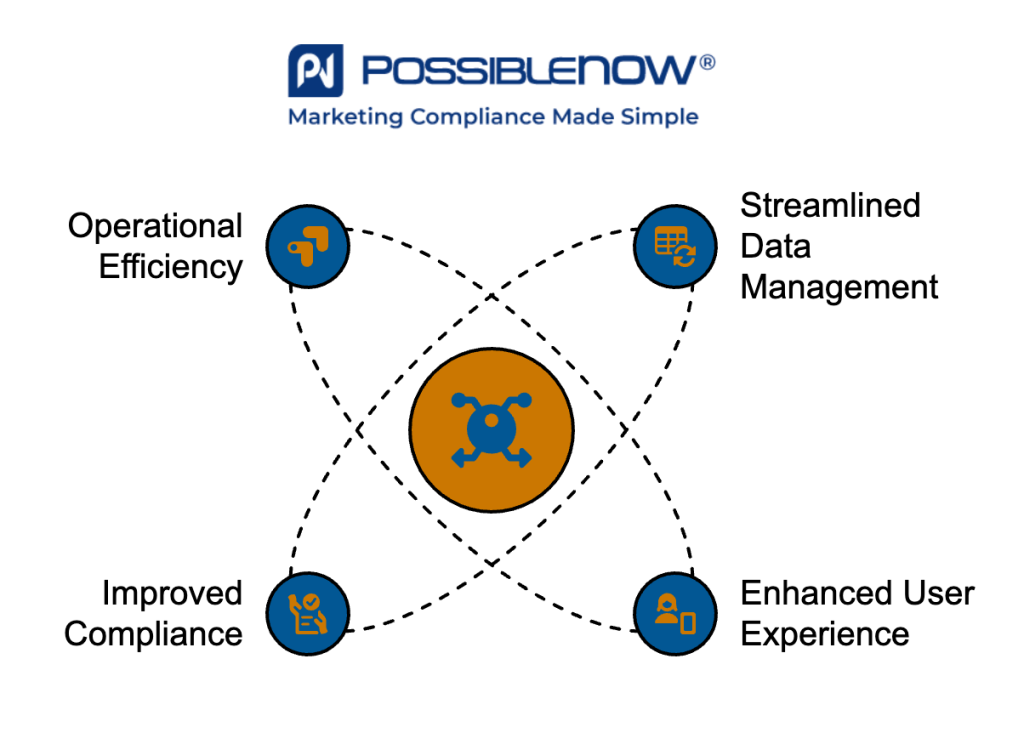
Integrating a CMP across the technology stack delivers measurable advantages beyond compliance.
Streamlined Data Management
A centralized consent repository eliminates duplicate records, conflicting statuses, and version control problems. Every system draws from the same source of truth, reducing the risk of errors and non-compliance.
Enhanced Customer Experience
When consent and preference data flows into marketing and CRM platforms, organizations can tailor content, channels, and frequency to each customer’s stated choices. That level of personalization improves engagement and reduces friction.
Reduced Compliance Risk
Fragmented consent records can allow one system to keep using customer data after permission has been withdrawn or preferences have changed. Depending on the communication channel and jurisdiction, these gaps may lead to:
- Regulatory investigations and financial penalties
- Consumer complaints and litigation
- Difficulty demonstrating valid consent during an audit or dispute
- Reputational damage and loss of customer trust
An integrated CMP helps mitigate these risks by distributing consent updates across connected platforms. It also preserves timestamped records of what the customer agreed to, when the choice was collected, where it originated, and which disclosure language was presented. This gives the organization a more defensible audit trail.
Operational Efficiency
Automated consent propagation reduces the manual work of updating suppression lists, verifying consent status before campaigns, and reconciling records across platforms. Teams spend less time on data management and more on execution.
What to Look for in a Consent Management Platform
Not every CMP is built for enterprise-scale integration. When evaluating platforms, organizations should prioritize these capabilities:
- API-first architecture that supports real-time, bidirectional data exchange with any system
- A broad library of pre-built connectors for CRMs, marketing automation platforms, and other martech tools
- A centralized consent repository that serves as the single source of truth for all consent and preference data across the organization
- Propagation logic that automatically cascades consent and preference changes across related records, channels, and business units
- Built-in compliance features including audit trails, consent language versioning, and support for jurisdiction-specific requirements
- Native Do Not Contact integration to connect consent management with DNC suppression in a single platform
Request a Demo Today
How MyPreferences Connects Consent Across the Enterprise
PossibleNOW’s MyPreferences is an enterprise consent and preference management platform designed for complex organizations. It centralizes consents, preferences, profile information, and customer-provided insights, then makes that data accessible across customer touchpoints.
MyPreferences® integration capabilities include:
- A broad connector ecosystem: More than 200 pre-built connectors and native applications support access to consent, preference, and Do Not Contact data across the technology environment.
- APIs and webhooks: Development teams can connect custom applications, build customer experiences, and automate data movement.
- Flexible data exchange: On-demand and recurring imports and exports support API-based processes and batch files.
- A Universal Consent Repository: Consent records, history, localization, preferences, contact elements, and channels can be managed within one central location.
- Real-time decision services: Native applications for Salesforce and Oracle Eloqua allow users to check current consent and preference information before executing campaigns.
- A Propagation Engine: Configurable rules apply consent and preference changes across related communication hierarchies, profiles, and contact methods.
- Business rules and data validation: Built-in controls help preserve consent records when email addresses, telephone numbers, or other contact details change.
- Enterprise configuration: Departments, teams, brands, and business units can maintain appropriate views while working from a shared platform.
MyPreferences supports seamless activation across the enterprise. It can connect with core business systems through pre-built integrations, APIs, webhooks, and file-based data exchange.
Disconnected consent data creates gaps between what customers request and what business systems do. MyPreferences provides the centralized records, configurable rules, and integration flexibility needed to apply customer choices across a complex enterprise.
Ready to see how MyPreferences integrates with existing systems? Learn what a consent management platform is and contact PossibleNOW to schedule a consultation.
-
TCPA Regulations and Compliance: Complete Guide
Type: Blog
Topic: Do Not Call Solution
-
Defining Meaningful Metrics: 6 Soft KPIs to Measure Customer Preference Collection
Type: Blog
Topic: Preference Mgmt
-
Email Preference Center Best Practices
Type: Blog
Topic: Preference Mgmt
-
The Basics of DNC Scrubbing: What Is a Do Not Call (DNC) Scrubber and Why Do You Need It?
Type: Blog
Topic: Do Not Call Solution
-
What is Consent Management, How it Works, & Why it’s Important for Data Compliance
Type: Blog
Topic: Consent Mgmt
-
Do Insurance Companies Cover TCPA Damages?
Type: Blog
Topic: Do Not Call Solution
-
8 Best Practices for Capturing GDPR Consent
Type: Webinars
-
Data Silos Cause Communication Gaps
Type: Videos
Topic: Preference Mgmt
-
Difference Between Preferences & Consent
Type: Videos
Topic: Preference Mgmt
-
Integrate Do Not Call Compliance with Preferences
Type: Videos
Topic: Preference Mgmt
-
Customer Preferences Require More Than One Flavor
Type: Videos
Topic: Preference Mgmt
-
Give Customers Opt-Down Options
Type: Videos
Topic: Preference Mgmt
-
Preference Center Organization
Type: Videos
Topic: Preference Mgmt
-
Strategic Consultants Benefited Scotiabank
Type: Videos
Topic: Industry Testimonials
-
The Ultimate DNC Compliance Checklist Before Launching Your Next Campaign
Type: Blog
Topic: Do Not Call Solution
-
The Impact of AI on Automating DNC Processes
Type: Blog
Topic: Do Not Call Solution
-
Why DNC Compliance Needs Regular Auditing
Type: Blog
Topic: Do Not Call Solution
View Other Resources


